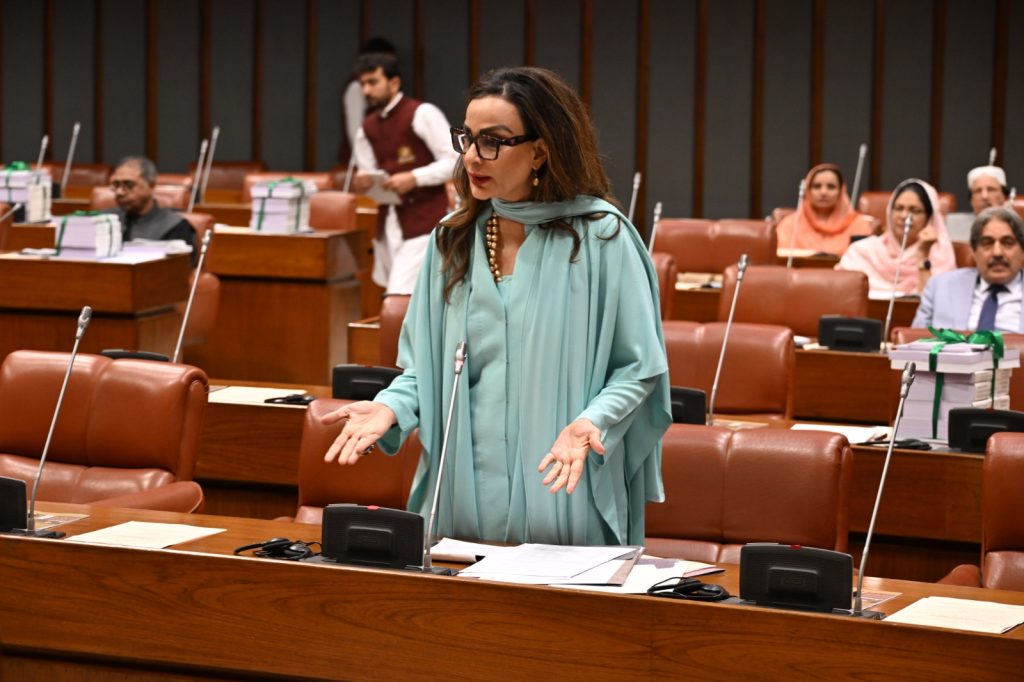
Senator Sherry Rehman, Vice President of the Pakistan Peoples Party, addressed the Senate on Tuesday, lauding what she termed a major diplomatic achievement for the nation while delivering a sharp critique of the federal budget’s structural flaws.
Rehman congratulated the nation on Pakistan’s constructive role in facilitating peace efforts amid escalating tensions between Iran and the United States. “Pakistan invested in hope, dialogue and diplomacy. The international community has acknowledged and appreciated these efforts,” she said.
She noted that Prime Minister Shehbaz Sharif had acknowledged the contributions of President Asif Ali Zardari, PPP Chairman Bilawal Bhutto Zardari, and the wider political leadership in supporting these diplomatic initiatives.
Economic Relief Through Regional Stability
Rehman highlighted the broader regional impact of peace, stating that stability in the Strait of Hormuz would strengthen global energy security, improve supply chains, and contribute to greater price stability. “We hope that reduced tensions will ultimately help bring down oil prices globally and in Pakistan, easing inflationary pressures and providing relief to ordinary citizens, particularly vulnerable households already struggling with rising costs,” she said.
With nearly 45 percent of Pakistan’s population living below the poverty line, Rehman emphasized that lower international energy prices offer “much-needed relief.” She declared, “Peace is not only a diplomatic achievement; it is also an economic necessity for millions of people.”
Critique of the Rs 18 Trillion Budget
Turning to domestic fiscal policy, Rehman argued that while the current budget offers economic stabilization, it fails to address growing fundamental challenges. She called for a more equitable taxation structure that increases direct taxation while reducing dependence on indirect taxes and sales taxes that disproportionately impact lower-income groups.
“The country’s fundamental problem is that it is living on borrowed money, which is clear when you see almost 50 percent of expenditures go into debt servicing,” she said. “Trade and service sectors need to contribute far more to national revenues to fix the gaping hole at the heart of the budget.”
Rehman expressed serious concerns over the continued expansion of the petroleum levy, noting it was originally introduced as a temporary measure. “There is a clear difference between tax and a levy. Levies do not flow to the provinces, while provinces are responsible for delivering health, education, and other essential public services,” she explained, warning that the petroleum levy is increasingly functioning like a sales tax that diverts money from the provinces.
Provincial Empowerment and Debt Servicing
Reiterating the importance of provincial empowerment, Rehman said that increasing levies should not come at the expense of provincial financial rights.Health and education are delivered largely through the provinces. If we want better outcomes for our citizens, provinces must have the fiscal space and resources necessary to perform these responsibilities effectively,” she said.
She noted that approximately 42.8 percent of the federal is absorbed by debt servicing. “When nearly half of the federal budget is consumed by debt obligations, the space available for development, social protection, and public investment becomes severely constrained,” she said.
Rehman criticized government bloat, noting that the entire PSDP plan costs less than the expenses of the federal government. She also pointed to staggering losses from state-owned enterprises, which reached Rs 832.848 billion in FY2025, with cumulative losses now standing at Rs 6.563 trillion. “Yet another Rs 451 billion has been allocated to SOEs in this budget. This is a structural challenge that cannot be ignored indefinitely,” she added.
Climate and Social Concerns
Rehman welcomed the removal of the 18 percent sales tax on sanitary pads and contraceptives, describing it as an important step towards improving affordability and access for women and families. She also stressed the need to create stronger incentives for businesses to address unemployment, currently at approximately 7 percent.
Expressing concern over declining climate allocations, Rehman said, “It is deeply concerning that climate-related levies are being collected with no clear path of those funds into decarbonisation. Pakistan is among the countries most vulnerable to climate change, and this is precisely the time when climate investment should be increasing, not decreasing.”
She warned that climate impacts are already affecting agricultural productivity and food security. “Pakistan was once a net exporter of major commodities such as wheat, cotton, and sugar. Today, climate pressures and longstanding structural challenges have increased our dependence on imports,” she said.
Concluding her remarks, Rehman called for a more inclusive budget-making process, suggesting that sales tax on goods could be given to provinces given their better collection record. She urged consultations to begin in January, well before the presentation of the next budget.