
Early Life
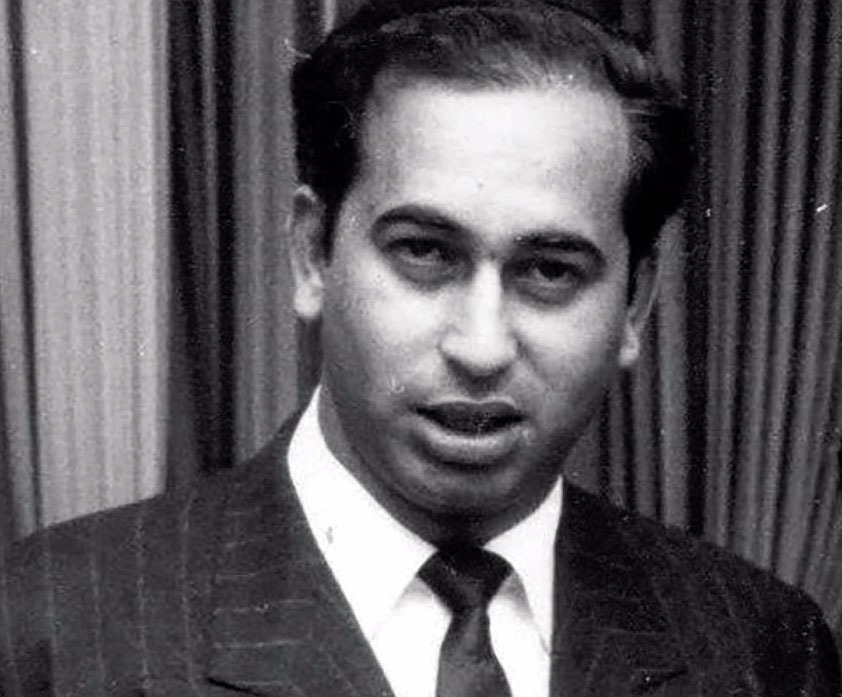
Zulfikar Ali Bhutto was born on 5 January 1928 in Ratodero, Sindh, into a prominent landowning family of Sindhi heritage. His father, Sir Shah Nawaz Bhutto, was a respected political figure and former prime minister of the princely state of Junagadh. Zulfikar received his early education at the Cathedral and John Connon School in Bombay and later at the University of Southern California. He completed his studies at the University of Oxford, graduating with honours in political science and jurisprudence, and was called to the bar at Lincoln’s Inn. His early exposure to law and politics shaped his vision for a progressive, democratic Pakistan.
Politics
Bhutto’s political career began as a member of President Iskander Mirza’s cabinet, but he rose to prominence as the Foreign Minister under General Ayub Khan. He championed Pakistan’s sovereignty and forged closer ties with China and the Muslim world. However, growing differences with Ayub Khan led him to resign in 1966. In 1967, he founded the Pakistan Peoples Party (PPP), a centre-left, pro-democracy party that called for “Roti, Kapra aur Makan” (Bread, Cloth, and Shelter) – a slogan that resonated with the masses. Bhutto’s oratory and populist appeal made him the voice of the opposition, leading to mass protests against Ayub’s regime, culminating in the 1969 military takeover by General Yahya Khan.
After the 1970 general elections (in which the PPP won a majority in West Pakistan), and the subsequent civil war in East Pakistan, Bhutto assumed the presidency in December 1971, becoming the first civilian chief martial law administrator. He quickly moved to restore democratic institutions, drafting the 1973 Constitution – Pakistan’s first unanimously approved constitution – and transitioning to the role of Prime Minister. His government nationalised industries, implemented land reforms, and pursued an independent foreign policy.
Defining Moments
- 1971 War & Separation of East Pakistan: Bhutto’s leadership during the crisis and his role in the Simla Agreement with India, which secured the return of occupied territories and the release of 90,000 Pakistani prisoners of war.
- Nuclear Program: In 1972, Bhutto convened the Multan Conference, launching Pakistan’s atomic bomb project. His famous declaration: “We will eat grass, but we will make a nuclear bomb.”
- Constitution of 1973: Unanimously passed, establishing a parliamentary federal system and protecting fundamental rights.
- Islamic Summit 1974: Hosted the second OIC summit in Lahore, strengthening Pakistan’s position in the Islamic world.
- Labour and Land Reforms: Introduced sweeping reforms to reduce inequality, improve workers’ rights, and break up large feudal estates.
Judicial Murder
The term “judicial murder” is often used to describe the trial and execution of Zulfikar Ali Bhutto. Following the 1977 military coup led by General Muhammad Zia-ul-Haq, Bhutto was arrested and charged with conspiracy to murder a political opponent, Nawab Muhammad Ahmed Khan Kasuri. The trial, presided over by the Lahore High Court, was widely criticised as politically motivated. Despite international pleas for clemency and doubts over the evidence, the Supreme Court upheld the death sentence by a narrow 4–3 verdict. On 4 April 1979, Bhutto was hanged at Central Jail, Rawalpindi. His execution remains a controversial and deeply painful chapter in Pakistan’s history, with many legal experts and historians considering it a grave miscarriage of justice.
“I am not afraid of death. I fear a life without purpose.”
— Zulfikar Ali Bhutto, last statement
Original Manifesto
The PPP Manifesto (1967)
Core principles: Democracy, socialism, and Islamic social justice. The manifesto called for:
- Roti, Kapra aur Makan – Food, clothing, and shelter for every citizen.
- Nationalisation of major industries and financial institutions.
- Land reforms and the abolition of feudalism.
- Free and compulsory education up to primary level.
- Protection of labour rights and social security.
- Independent foreign policy based on non-alignment.
- Islamic values as the moral foundation of the state.
“The PPP is the voice of the common man – it stands for equality, justice, and the dignity of the individual.”
This tribute covers the life, politics, defining moments, the controversial trial, and the enduring manifesto of Zulfikar Ali Bhutto – a leader whose legacy continues to shape Pakistan.