ISLAMABAD — Pakistan Peoples Party (PPP) Chairman Bilawal Bhutto Zardari issued a stark warning on Tuesday, declaring that India’s unilateral suspension of the Indus Water Treaty (IWT) poses an existential threat to Pakistan and vowing to defend the nation’s water rights by any means necessary.
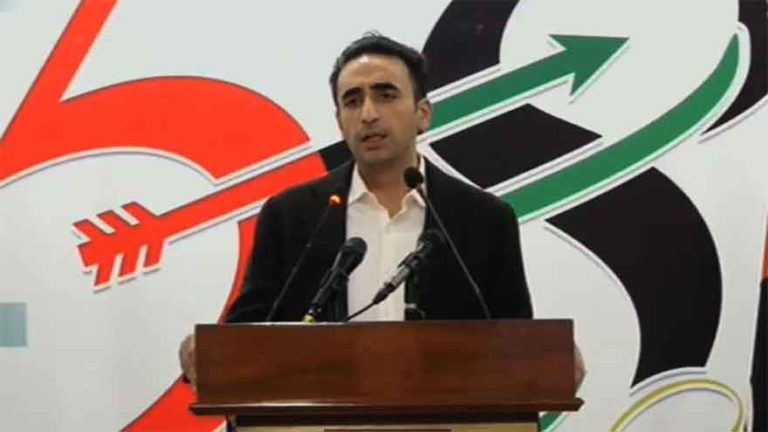
Speaking at an international seminar on the Indus Water Treaty in Islamabad, Bilawal framed the dispute as far more than a technical disagreement, drawing parallels to the recent closure of the Strait of Hormuz, which he described as a “weaponization of a waterway.”
“We meet at a grave hour, at a time when the world has been reminded that a waterway is not merely geography, it is power, commerce, food, fuel and life,” Bilawal said in his keynote address. “Just as no ceasefire and no peace could be achieved between the US and Iran with the Strait of Hormuz shut, similarly, how can any ceasefire between India and Pakistan hold without the Indus Water Treaty being restored?”
A Threat to National Survival
Bilawal accused India of abandoning the treaty as part of an “unjustified assault” on Pakistan last summer, noting that Pakistan emerged victorious in that conflict. However, he cautioned that while Pakistan has adhered to the subsequent ceasefire, India has not returned to its obligations under the IWT.
“Let there be no ambiguity in Islamabad, New Delhi, Washington, Beijing, London and the United Nations, this is not a technical dispute,” Bilawal stressed. “This is not a clerical clash between commissioners, or a matter of paperwork, hydrology or administrative issues, but the weaponization of water.”
The PPP chairman emphasized the treaty’s critical role in Pakistan’s survival, describing the Indus River as the nation’s “bread, cotton, wheat, fields of Sindh, orchids of Punjab, waters of Khyber Pakhtunkhwa, channels of Balochistan.”
“To cut the Indus is not to pressure a government, but to threaten a people,” he said. “Pakistan has over 200 million souls—no state, no PM, no army, no court, no parliament, no political party, and no generation has the right to stand silent while the lifeline of those souls is placed under the shadow of coercion.”
Call for National Unity and Military Preparedness
Bilawal urged a comprehensive national response, warning that water strangulation must be treated as a “national security assault” rather than a diplomatic irritant. He called for unity across political parties, provinces, and state institutions.
>“Let there be unity in the Parliament and clarity at the GHQ, let be resolve in the foreign office. Let there be urgency across the government,” he said.
While reiterating that Pakistan does not seek war, Bilawal warned that the nation must be prepared to respond militarily if necessary. “If we see an attack on our rivers as a military assault, we must respond militarily as well,” he stated.
He outlined a series of measures, including modernizing irrigation, investing in drip irrigation and smart agriculture, exploring desalination and water recycling, and pursuing regional water cooperation, including potential water imports from Central Asia.
Demand for New International Law
Bilawal called for a new international convention against the weaponization of waterways, arguing that current legal frameworks are insufficient. He proposed that such a convention should apply to maritime chokepoints like the Strait of Hormuz and transboundary rivers like the Indus.
“The 20th Century feared the bomb, the 21st Century must also fear the faucet controlled by a hostile hand,” he said.
Message to India and the World
Addressing India directly, Bilawal said: “You cannot build greatness on the thirst of another people. You cannot call yourself a civilization while threatening another civilization’s river.”
He concluded with a defiant message: “The Indus is not a bargaining chip or a weapon to be in India’s hands. It is a lifeline of Pakistan, and any attempt turn it into a noose must be treated as a threat to the survival our state.”
Bilawal ended his speech by raising the slogan “Marsoon Marsoon, Sindhu na Desoon” (We will die, but not give up the Indus).